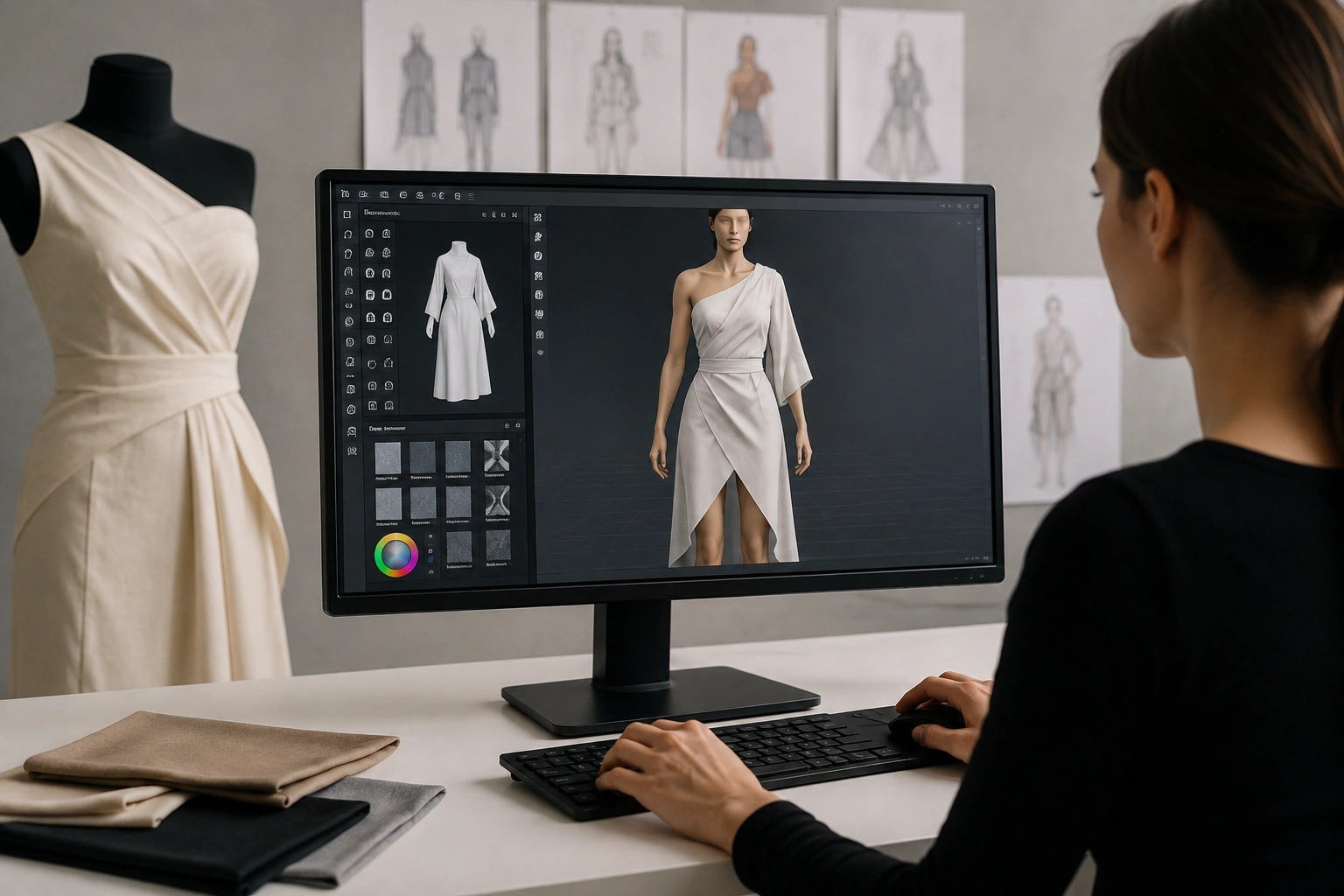
3D fashion design means building a garment as a simulated digital object instead of drawing it flat and cutting cloth to see whether it works. A pattern is stitched digitally, a fabric with measured properties is assigned, and the software calculates how that cloth falls on a virtual body. The result is not a picture of a design but a testable version of one, so fit, drape, and seam placement can be judged before anything is cut.
What 3D Fashion Design Actually Involves
The workflow begins with a pattern, drafted in the software or imported from CAD. Panels are arranged around a parametric avatar and seams defined. A fabric carrying measured values for weight, thickness, stretch, and bending stiffness is applied, and the simulation solves how it behaves against the body. The same file then exports the pattern, measurements, and construction detail a factory needs.
How It Differs From Illustration and Rendering
Illustration and CAD flats communicate intent; a render is a picture made to look convincing. A 3D garment is constrained by two things that cannot be faked: a pattern that must close correctly, and fabric parameters that were measured, not guessed. A wrong pattern shows up as puckering or strain.
Why Digital Fabric Is Half the Work
A digital garment is only as accurate as its material. Fabric digitisation means testing a swatch for weight, stretch, and bending behaviour, then scanning it for colour, weave, and texture. Feed the simulation a generic preset and the garment behaves nothing like the real thing. Mills now build digital swatch libraries for this reason.
Why the Industry Moved to 3D Clothing Design
The reason is financial. Every physical sample consumes fabric, trims, labour, and courier time, and a style commonly runs to three to five rounds before approval. Across hundreds of styles a season it becomes one of the costliest parts of development, while a digital iteration takes hours. The second is geography: a buyer in Europe, a merchandiser in Mumbai, and a factory in Tirupur review the same file instantly.
3D does not eliminate physical sampling. Brands still make fit and pre-production samples, because a screen cannot tell you how a fabric feels, behaves after washing, or how a factory reads a seam finish. The gain is fewer rounds, not zero samples.
The Software the Industry Actually Uses
A small group of tools dominates and they are not interchangeable. CLO 3D is the most widely used entry point, especially in education and small studios, and is strong on photorealistic simulation. Browzwear's VStitcher is built for enterprise development and ties the garment into tech packs and factory workflows, which is why large brands standardise on it. Style3D is a fast-growing cloud option, alongside CAD-rooted platforms such as Optitex, Lectra, and Tukatech.
For a student, learn one tool properly rather than three superficially. CLO 3D is the sensible first choice in India: widest entry-level demand, most learning material, affordable student access. The underlying logic transfers, so moving to Browzwear later means learning an interface.
What Changes Inside the Design Process
Decisions move earlier. Fit and proportion are traditionally argued over once a sample exists, weeks after sign-off; in a 3D workflow that happens at the design stage. It also raises the technical floor, since the simulation exposes weak pattern knowledge immediately. Learning 3D increases how much pattern-making you need to know, not less.
Where 3D Is Reshaping the Wider Fashion Industry
Product Development and Virtual Sampling
This is the largest and least visible impact, and where most of the money is. Digital sampling compresses calendars, cuts sample costs, and lets brands carry more options further before committing.
Retail Imagery and Virtual Try-On
An accurate 3D asset can be reused. Brands generate e-commerce imagery, on-model shots, and campaign visuals from the file, sometimes before stock exists. Fit tools on the same avatars aim to cut returns, though try-on accuracy remains uneven across real bodies.
Waste, Overproduction and Sustainability
Sample reduction is a real gain and routinely overstated, since sampling is small next to material production, manufacturing volume, and unsold inventory. The more meaningful contribution is upstream: better decisions before commitment, sharper forecasting, and a path to made-to-order production.
Digital-Only Garments and Brand Content
Garments existing only as digital objects, in games, AR, and campaign content, are the most talked-about part of fashion innovation and the smallest commercially. A real niche, but not where the bulk of employment sits.
Traditional Sampling and 3D Garment Design Compared
The table below compares the two approaches on the factors that matter in practice.
| Factor | Traditional Sampling | 3D Garment Design |
|---|---|---|
| First view of the design | Flat sketch, then a stitched sample weeks later | Simulated garment on an avatar within hours |
| Cost per iteration | Fabric, trims, labour and courier for every round | Near zero once the software and fabric data exist |
| Time per iteration | Days to weeks, longer across countries | Minutes to hours, reviewed remotely |
| Fit and drape decisions | Made late, on a physical sample | Made early, with tension and strain maps |
| Fabric behaviour | Fully accurate, including hand feel and wash | Accurate only if the fabric was properly digitised |
| Cross-team review | Sequential, dependent on shipping samples | Simultaneous, brand and factory on one file |
| Waste per style | Several discarded samples and offcuts | Fewer rounds, though final samples remain |
| Skills required | Pattern-making, construction, fabric handling | All of those plus software, material data, rendering |
| Main limitation | Slow, costly, limits how many options get tested | Cannot judge hand feel, wash behaviour or finishing |
The two are complements rather than substitutes. Most brands resolve design and fit digitally, then confirm with fewer physical samples.
What 3D Fashion Design Does Not Replace
Students sometimes read 3D as a way around the difficult parts of the training. It is the opposite. Pattern-making, construction, and fabric knowledge are the inputs a 3D workflow runs on, and garments built without them fail the moment a factory makes them. Nor does 3D supply a point of view: research, judgement, and knowing who a garment is for remain scarce.
Careers Built on 3D Fashion Design
The clearest role is the 3D fashion designer or digital apparel developer, taking designs from pattern to simulated garment. Adjacent to it sit technical designers using 3D for fit and grading, material specialists maintaining fabric libraries, and asset artists producing garments for e-commerce and gaming.
In India the work sits where export and e-commerce are: Bangalore, Delhi-NCR, Mumbai, Tirupur, and Pune. Entry salaries match other junior design roles, and the differentiator is solid pattern-making combined with 3D capability, still an uncommon pairing. Being file-based, the work also suits freelance projects for overseas brands.
How to Learn 3D Fashion Design in a Sensible Order
The order matters more than the speed. Build pattern-making and construction on real cloth first, then add flat drawing and tech pack literacy. Only then take one 3D tool and work through complete garments end to end. Learn fabric digitisation last, since material accuracy separates a convincing garment from a decorative one.
A degree-level fashion design course suits this progression better than a short software certificate, because the pattern-making, textile, and production subjects 3D depends on are built into the curriculum rather than assumed. This guide to fashion designing course fees and eligibility sets out the usual options in Pune.
For the portfolio, show the working: the pattern beside the simulated garment, a tension map and what you changed because of it, and one project where the digital garment was actually sewn.
When assessing institutes, ask which 3D tool is taught, whether every student gets a licence and machine time, and whether fabric digitisation is covered or only presets. Such detail is usually published on an institute's admissions page. Among design institutes in Pune, NIF Global Kondhwa runs its fashion programmes at degree level, from BVoc and BDes through to MVoc and MDes, with NSDC and Skill India approved certification, set out on the fashion design course page.
What Is Likely to Change Next
AI-assisted ideation is being wired into 3D pipelines, so generated concepts feed a simulation that tests whether they can be constructed. Material libraries are becoming standardised across brands and factories, and avatars improve as body-scan data improves. Further out, 3D becomes the input to on-demand production, though timelines will be slower than announcements suggest.
Frequently Asked Questions
What is 3D fashion design in simple terms?
A pattern is stitched in software, a measured fabric applied, and the programme calculates how the garment drapes on a virtual body, so fit is judged before anything is cut.
Do I need pattern-making before learning 3D fashion design?
Yes. A 3D garment is built from a pattern, so weak pattern knowledge produces garments that simulate badly and cannot be manufactured.
Which 3D fashion design software should a beginner learn first?
CLO 3D, for most students in India: widest entry-level demand, affordable access, plenty of learning material. Browzwear is more common in enterprise production and easier to pick up later.
Is 3D fashion design replacing traditional fashion designers?
No. Execution gets faster, so research, concept, and material judgement matter more. What it does displace is designers who cannot work digitally at all.
What kind of computer is needed for 3D garment design?
A dedicated graphics card, with 16 GB of RAM as a working minimum and more for rendering. Check what hardware an institute provides before buying your own.
Are there 3D fashion design jobs in India?
Yes, and growing, concentrated in Bangalore, Delhi-NCR, Mumbai, Tirupur, and Pune, because overseas buyers now expect digital submissions.
Does 3D fashion design genuinely reduce waste?
It reduces sample waste measurably, though sampling is a modest share of fashion's footprint. The larger benefit is indirect, through better pre-production decisions.
Can I learn 3D fashion design without a fashion design qualification?
You can learn the software, and self-taught designers do find freelance work. Harder to acquire alone is the pattern-making and production knowledge the software assumes.
Where This Leaves You
3D fashion design is a change in where design decisions get made, not a new aesthetic. Judgements that once waited for a physical sample now happen at the design stage, compressing calendars, cutting cost, and raising the technical demands on the designer.
For a student, the conclusion is unromantic. Get the fundamentals, learn one 3D tool to a production standard, and build a portfolio that proves a factory could make what you designed. If you are comparing programmes in Pune, an enquiry or campus visit shows which institutes teach 3D as an integrated part of design training.