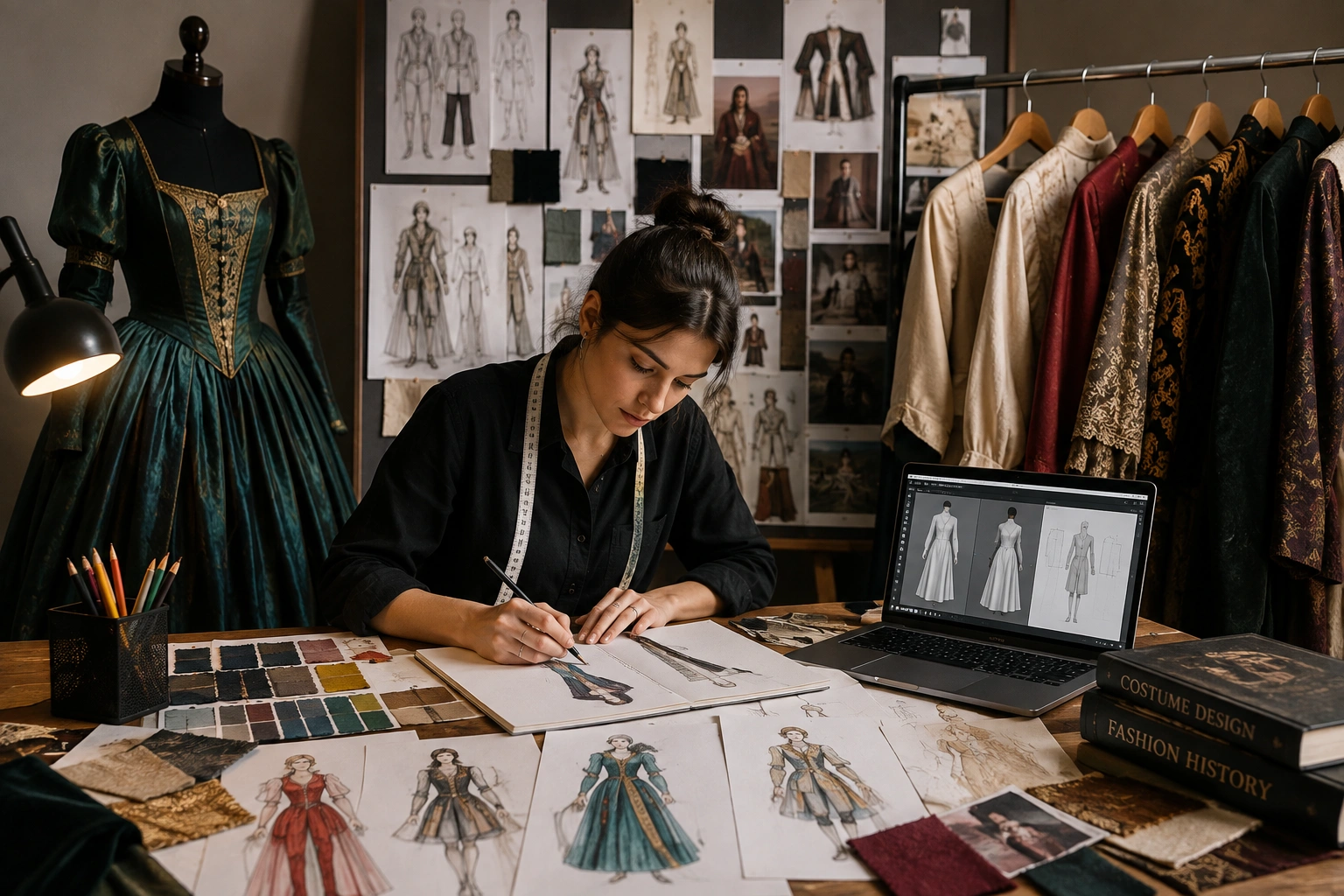
Every character on screen or on stage arrives dressed for a reason. What they wear signals their period, class, region, mood and often the point they have reached in the story, and someone has made every one of those decisions deliberately. That person is the costume designer. This guide explains what the role involves, the skills it demands, the education routes available in India, and how to become a costume designer if it is the direction you want your career to take.
Who Is a Costume Designer?
A costume designer is responsible for the complete visual wardrobe of a film, television series, web series, theatre production, advertisement or live performance. The work goes well beyond selecting clothes. It begins with reading the script, understanding each character's background and arc, and then researching the period, region and social setting the story occupies. From there the designer develops sketches, sources or commissions fabric, supervises construction and manages fittings through the shoot. The role sits at the intersection of design, storytelling and production management, which is what separates it from styling.
A stylist works with existing garments to create a look, usually for a real person. A costume designer works with a fictional character and is often creating garments that do not exist yet, in quantities and conditions that a shoot demands. On a large production the same outfit may need to be made several times over to allow for damage, weather effects and continuity across scenes shot weeks apart.
What Does a Costume Designer Do Day to Day?
The work divides roughly into three phases. During pre-production the designer breaks down the script scene by scene, builds character boards, researches references, presents design concepts to the director, and finalises budgets. This is the most design-intensive stage and often the longest on a period project.
Production is largely execution and problem solving: managing fittings, tracking continuity, coordinating with the hair, makeup and art departments so the palette holds together, and handling the daily crises that come with shooting schedules. Post-production is lighter, involving reshoot support, archiving and returns. Across all three phases the designer is managing a team that may include assistant designers, pattern masters, tailors, embroiderers, dressers and standby crew.
What the Ramayana Costumes Show About the Craft
The costume work on Nitesh Tiwari's two-part Ramayana adaptation, with Part 1 scheduled for a Diwali 2026 release, has drawn attention to the scale this role can reach. Costumes for the film are being created by the design duo Rimple and Harpreet Narula, who have built original pieces for the production rather than adapting existing wardrobes, with reports describing extensive use of metallic work and handcrafted detailing for the film's antagonist.
For students, the useful takeaway is not the budget but the method. A project of this kind involves months of visual research, close collaboration with directors and production designers, extensive costume trials before filming begins, and coordination with craft clusters and karigars who execute the handwork. It also demonstrates how much of Indian costume design depends on traditional textile and embroidery skills, and why understanding those crafts is a professional advantage rather than a nostalgic one.
Costume Designer Skills That Matter
- Sketching and illustration to communicate a character's look clearly
- Pattern making, draping and garment construction knowledge
- Textile and fabric literacy, including how materials read on camera and under lights
- Historical, regional and cultural research ability
- Colour theory and an understanding of how palettes support a narrative
- Budgeting, sourcing and vendor management
- Team coordination and the stamina for long, unpredictable shoot schedules
Among these costume designer skills, research and construction knowledge are the two most frequently underestimated. A designer who cannot explain why a particular weave, drape or silhouette belongs to a period will struggle on any historical project, and one who cannot brief a tailor precisely will lose control of the final result.
How to Become a Costume Designer: The Practical Route
There is no single mandated path, but most working designers follow a similar progression. The usual starting point is a formal design education, since it delivers pattern making, textiles, illustration and construction in a structured sequence. A costume design course or a broader fashion design programme both work; what matters is that the technical foundation is properly covered.
The second step is assisting. Almost every established costume designer in India began as an assistant or intern on set, and this is where the practical knowledge is acquired: continuity systems, on-set etiquette, department coordination and how quickly decisions have to be made under pressure. Two to four years in assisting roles is common before a designer takes independent charge of a project.
Building a portfolio runs alongside both. Student films, theatre productions, short films, independent music videos and college fests all produce usable work, and a portfolio showing character breakdowns and finished results carries far more weight than one showing sketches alone. Networking follows naturally from this, since most costume design work is secured through referrals rather than applications.
Costume Design Course and Degree Options
Dedicated costume design degree programmes exist in India but are limited in number, so many designers enter through fashion design instead. A costume design degree at bachelor level offers the most complete grounding, while diplomas and certificates suit students who want to enter the workforce sooner or who are adding a specialisation to existing skills. The table below summarises the common options.
| Course Type | Eligibility | Duration | Approximate Fee Range |
|---|---|---|---|
| Certificate in Costume Design | Class 10th pass | 3–6 Months | Rs 25,000 – Rs 1,00,000 |
| Diploma in Fashion / Costume Design | Class 10th or 12th pass | 1–2 Years | Rs 50,000 – Rs 2,00,000 |
| BDes / BVoc in Fashion Design | Class 12th pass | 3–4 Years | Rs 1,50,000 – Rs 8,00,000 total |
| MDes or PG Diploma | Bachelor's degree | 1–2 Years | Rs 1,00,000 – Rs 5,00,000 total |
Fees vary considerably by institute and city, and the figures above are indicative rather than fixed. Prospective students should confirm current fees, eligibility and specialisation options directly with the institute they are considering.
Costume Designer Job Opportunities and Career Growth
A costume designer job today extends well beyond feature films. Streaming platforms have expanded demand substantially, with series work offering longer engagements and more consistent income than individual film projects. Other employers include theatre companies, advertising and commercial production houses, music video producers, event and wedding production companies, television channels, dance and performance troupes, and increasingly gaming and animation studios that need character wardrobe design.
Typical progression runs from intern to costume assistant, then associate designer, then independent designer, and eventually to leading large productions or running a personal studio. Earnings vary widely and are usually project based rather than salaried. Assistants commonly start in the range of a few lakhs per annum equivalent, while established designers on major productions negotiate per project fees that can be substantially higher. A costume design career therefore tends to be uneven in the early years and to stabilise once a designer has credits and relationships to draw on.
Is Costume Design the Right Career for You?
The work suits people who enjoy research as much as design, and who are comfortable with long hours, tight timelines and creative decisions made under production pressure. It rewards patience: the early assisting years are demanding and relatively low paid, and recognition tends to arrive slowly. What it offers in return is a rare combination of craft and storytelling, and a discipline where technical skill and historical curiosity are equally valuable.
Frequently Asked Questions
How to become a costume designer in India?
Most designers complete a costume design or fashion design course covering pattern making, textiles and illustration, then work as an assistant on film, television or theatre productions for a few years while building a portfolio. Independent projects usually follow once credits and industry contacts are established.
What qualification do you need to be a costume designer?
There is no mandatory qualification, but a costume design degree, diploma or fashion design programme is the usual route. What matters most to employers is demonstrated skill in construction, research and visual storytelling, supported by a portfolio and on-set experience.
What is the difference between a costume designer and a stylist?
A stylist assembles existing garments to create a look, usually for a real person. A costume designer develops a character's wardrobe from the script upward, often designing and constructing garments from scratch while managing continuity, budgets and a production team.
What skills does a costume designer need?
Core costume designer skills include sketching, pattern making, fabric and textile knowledge, historical and cultural research, colour theory, budgeting and team coordination. Strong research and construction knowledge are the two most valuable on period and large-scale productions.
Is costume design a good career option?
It can be, particularly with the growth of streaming platforms and regional production. A costume design career is usually project based and slow to build in the early years, but offers strong creative scope and steady demand for designers with solid technical skills.