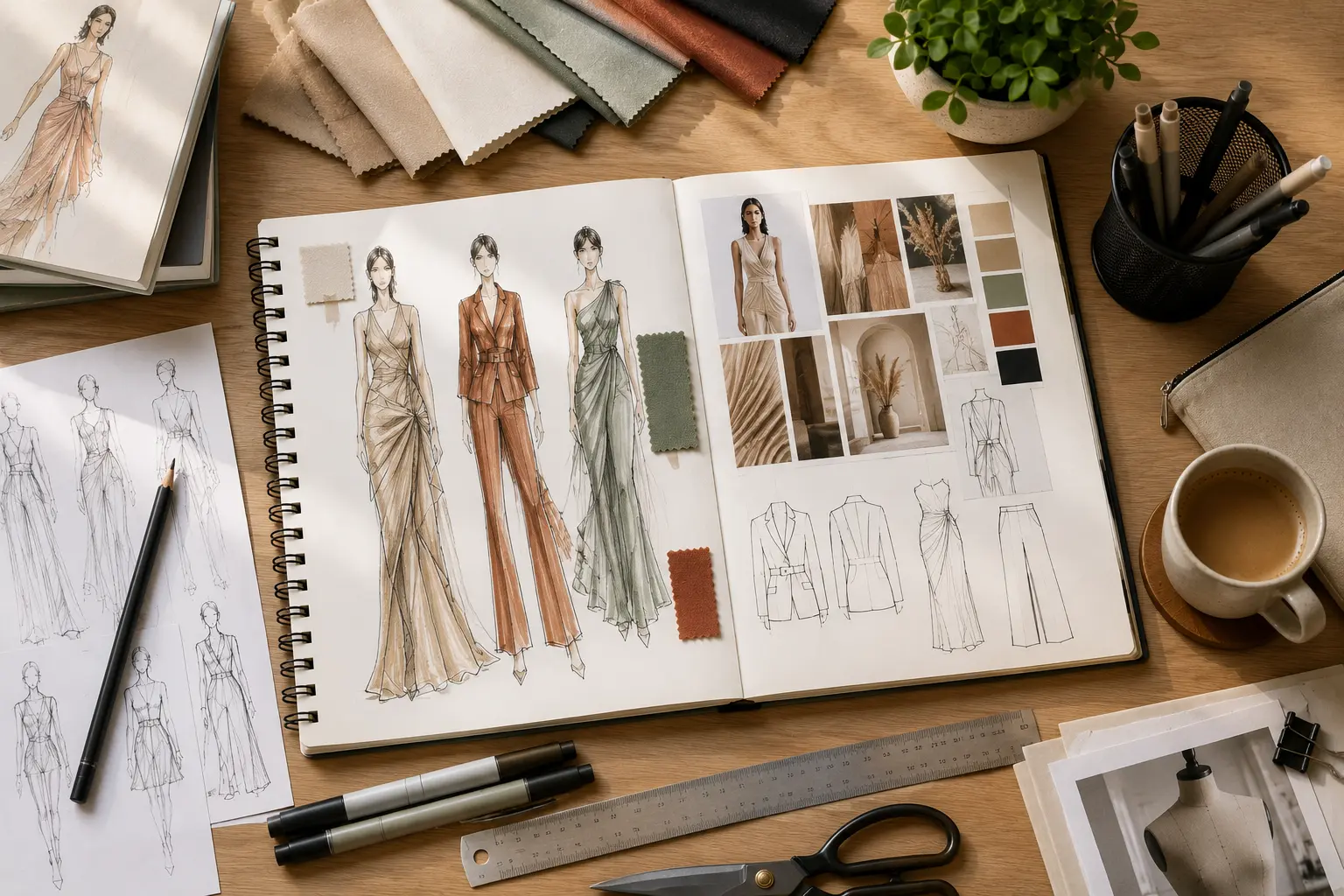
Your portfolio is your first interview. Before a recruiter reads your resume or an admission panel hears your name, they have already formed an opinion based on what they see in your portfolio. If you are wondering how to make a fashion design portfolio that actually opens doors, you are in the right place.
This guide covers everything: what to include, how to structure it, which tools to use, how to build one for college admissions, and what employers look for in a job portfolio. Whether you are a complete beginner or a student who has done some design work but never put it together formally, this step-by-step guide will help you build a portfolio that speaks for you.
What Is a Fashion Design Portfolio?
A fashion design portfolio is a curated collection of your best design work. It demonstrates your creative thinking, technical skills, and design process to anyone evaluating you, whether that is a college admission committee, a fashion house recruiter, or a freelance client.
There are two distinct types of portfolios, and it is important not to mix them up.
Personal Portfolio: This is your complete body of work. It includes every collection, project, and experiment you are proud of. You bring this to interviews and use it to show the full range of your abilities over time.
Specific Portfolio: This is a tailored version prepared for a particular opportunity. If you are applying for a jersey design role, your specific portfolio highlights your best jersey work. If you are applying to a fashion design college, it showcases work that meets that institution's requirements. This is what you send before an interview, not what you bring to one.
Understanding this difference changes how you approach the entire process of building your portfolio.
Fashion Design Portfolio Requirements: What Must Go Inside
Before you open Canva or pick up a sketchbook, you need to know the fashion design portfolio requirements that every strong portfolio must meet. The specific contents will vary depending on your goal, but the core elements remain consistent.
Every fashion design portfolio should include an introduction page, concept mood boards, hand-drawn and digital sketches, photographs of finished garments or styled looks, a colour palette and fabric reference section, and your contact details. For job applications in fast fashion, technical flat drawings are also essential. For college admission portfolios, process documentation showing how your ideas evolved matters as much as the final result.
Think of it this way: a recruiter or admission panel wants to understand your mind, your hands, and your vision. Each section of your portfolio answers one of those three questions.
How to Write the Fashion Design Portfolio Introduction Page
The fashion design portfolio introduction page is the first thing anyone reads, and most students either skip it entirely or make it far too long. Both are mistakes.
Your introduction page should be no more than seven lines. It should tell the reader who you are as a designer, what inspires your work, what this portfolio contains, and what kind of design sensibility they can expect to find. It is not a biography. It is a frame.
Here is a simple structure that works:
Open with your design identity in one sentence. Follow with two sentences on your inspiration or the philosophy behind your work. Then add two sentences describing the collections or projects included. Close with one line about your goals as a designer.
For example: "I design with structure and story in mind. My work is shaped by the tension between Indian craft traditions and contemporary silhouettes. This portfolio includes three collections developed during my fashion design program at NIF Global Kondhwa, each exploring a different facet of that tension. I am drawn to wearable design that carries cultural meaning without becoming a costume. My goal is to build a career at the intersection of heritage textile and modern ready-to-wear."
That is it. Clear, specific, confident, and short enough to actually be read.
How to Make a Fashion Design Portfolio: Step-by-Step
Here is the full process of how to make a fashion design portfolio from scratch, broken into eight clear steps.
Step 1: Define Your Goal First
The single biggest mistake students make is building a generic portfolio. A portfolio for a NIFT or NID entrance exam looks very different from one you send to a fashion brand for a job, and both look different from one you use to attract freelance styling clients. Before you select a single piece of work, decide what this portfolio is for. That decision shapes every choice that follows.
Step 2: Select Your Best Work, Not All Your Work
Quality always beats quantity. A portfolio with eight outstanding pieces is far stronger than one with twenty average ones. Go through everything you have produced and identify the work that best represents your skills, your range, and your point of view. If you are just starting out and do not have finished garment photos, strong sketches and mood boards will do. What matters is that every page earns its place.
Step 3: Choose a Portfolio Theme
A theme gives your portfolio a visual identity. It is what makes someone flip through it and feel a coherent point of view rather than a random collection of work. This is where fashion portfolio theme ideas come in, and your theme does not need to be complicated. It can be a colour palette, a layout style, a recurring visual motif, or a tonal direction. The key is consistency across pages.
We cover specific fashion portfolio theme ideas in detail in the section below.
Step 4: Build Your Concept Boards
Mood boards show how you think before you design. They should include reference images, fabric swatches or photographs of fabric, colour palettes, sketches, and anything else that captures the inspiration behind your collection. One to two pages per collection is sufficient. Any more and your portfolio becomes crowded. The mood board is context, not the centrepiece.
Step 5: Document Your Design Process
Show the journey from concept to finished piece. Include rough sketches alongside refined ones. Show fabric experiments, colour tests, and construction details. This process documentation is especially important for college admission portfolios. Panels want to see that you can think through a design problem, not just produce a pretty final result.
Step 6: Photograph Your Work Professionally
Poor photography can ruin strong work. If you have finished garments, photograph them on a model or a well-lit mannequin against a neutral background. Avoid cluttered backgrounds, bad lighting, and blurry shots. If you are working with sketches and flat designs, scan them at high resolution rather than photographing them. The standard of your images tells a viewer how seriously you take your own work.
Step 7: Build It Using a Portfolio Tool
Once your content is ready, you need to assemble it. We cover the best fashion design portfolio maker tools in a dedicated section below. Whether you go with Canva, Behance, or a custom website, your digital presentation needs to be clean, fast-loading, and mobile-friendly.
Step 8: Get Feedback Before You Submit
Never submit a portfolio without showing it to someone whose opinion you respect. That could be a mentor, a senior student, a faculty member, or a working designer. Ask them specifically: Is the theme consistent? Is anything confusing? Does every piece earn its place? Feedback before submission is always cheaper than rejection after it.
Fashion Portfolio Theme Ideas: 6 Directions That Work
Choosing a theme is one of the decisions students find hardest, mostly because they try to make it more complicated than it needs to be. Here are six fashion portfolio theme ideas that work particularly well for Indian design students and are distinct enough to make a portfolio memorable.
1. Minimalist Editorial: Clean white or off-white layouts, generous white space, one accent colour, and a strong typographic identity. This theme lets your garments and sketches do all the talking. It works best when your design work is bold and detailed enough to carry a quiet background.
2. Indian Craft Fusion: Draw from India's rich textile heritage. Use block print textures, handloom swatches, or indigo-dyed motifs as background elements or section dividers. This theme is particularly powerful if your design work incorporates craft-based techniques like Tie and Dye, Fabric Manipulation, or Kalamkari. It signals a strong design identity rooted in place.
3. Sustainability Forward: Earthy tones, natural textures, recycled material swatches, and a layout that feels considered and low-waste in its aesthetic. This theme aligns with where the global fashion industry is heading and signals awareness of the larger conversation your work lives inside.
4. Monochrome Drama: A high-contrast black and white palette throughout the portfolio, with one strategic colour used for accent. This theme requires strong, graphic design work to support it but looks exceptionally professional when executed well.
5. Streetwear Culture: Bold typography, layered imagery, urban photography references, and graphic energy. Best suited for designers whose work pulls from youth culture, sportswear influence, or contemporary casual wear. This theme reads as current and commercially aware.
6. Heritage Textile Revival: Built around the stories of specific Indian textiles, whether Ikat, Banarasi, Chanderi, or Kanjivaram. Each section of the portfolio connects to a textile tradition and shows how you have reinterpreted it through contemporary design. This is a theme that no international school or recruiter can replicate from their own context, which makes it a genuine differentiator for Indian students.
Best Fashion Design Portfolio Maker Tools
Once your content is ready, the right fashion design portfolio maker helps you present it professionally. Here are the most widely used options, each suited to a slightly different context.
Canva: The fastest way to build a polished digital portfolio. Canva has a large library of presentation templates that can be adapted for fashion portfolios. It is free for most features, exports cleanly as PDF, and requires no technical skill. Ideal for students building their first portfolio or anyone who needs a quick, clean presentation.
Behance: Adobe's portfolio platform and the most widely recognised name in creative industries globally. A strong Behance profile gets discovered by recruiters without any additional promotion. It also integrates with Adobe Creative Cloud, which is useful if you are already working in Illustrator or Photoshop. Best suited for digital-first portfolios aimed at professional opportunities.
Adobe Portfolio: Included free with any Creative Cloud subscription. It builds a clean, website-style portfolio that is personalised and professional. Slower to set up than Canva but more flexible in layout and branding. A good middle ground for students with some Adobe experience.
Wix or Squarespace: Full website builders that allow complete control over design, layout, and branding. Best for designers who want a standalone portfolio website rather than a PDF or platform-based page. Takes more time to set up but produces the most personalised result.
Issuu: A digital publishing platform that makes PDF portfolios look like professional magazines. Particularly effective for sharing a PDF portfolio via a link rather than an attachment. Very easy to use and free for basic accounts.
For most students starting out, the recommendation is to build a clean PDF using Canva and upload it to Behance. That combination gives you a shareable link, professional presentation, and discoverability on one of the most respected creative platforms in the world.
How to Make a Fashion Design Portfolio for College Admissions
If you are figuring out how to make a fashion design portfolio for college, the process has some important differences from a job application portfolio. Admission panels are evaluating potential, not just finished skill. They want to see that you can think creatively, draw with intention, and show curiosity about design as a discipline.
For entrance exams and admissions at institutions like NIFT, NID, Pearl Academy, or NIF Global Kondhwa, here is what panels typically want to see.
Hand-drawn sketches matter enormously. Even if you have strong digital design skills, admission panels want evidence that you can draw. Original sketches show hand-eye coordination, design sensitivity, and the foundational craft of fashion design. Do not submit only computer-generated work for a college admission portfolio.
Show process, not just outcomes. A page that shows rough concept sketches evolving into a refined final design tells a much better story than a single polished image. Panels want to understand how you think, not just what you can produce with enough time and software.
Keep it between twelve and twenty pages for most institutions. Any shorter and it feels underdeveloped. Any longer and it risks losing the panel's attention. Edit ruthlessly.
Include a variety of work types: observational sketches, concept boards, garment constructions or draping experiments, and any projects that show interest in design beyond fashion alone, such as interior sketches, graphic explorations, or textile experiments.
At NIF Global Kondhwa, students begin working on portfolio-quality projects from the very first semester. The curriculum is structured around practical assignments that build toward a strong body of work, which is exactly the kind of foundation that college admission portfolios need. If you are preparing for fashion design college admissions in Pune and want to understand what strong portfolio work looks like, our faculty mentors work closely with students through that process.
Fashion Design Portfolio Examples for Job Applications
A portfolio built for job applications operates differently from a college admission portfolio. When it comes to fashion design portfolio examples for job submissions, the rules shift toward commercial relevance, technical competence, and fit with the brand you are targeting.
The first thing to understand is that your job portfolio should be tailored to each application. A portfolio you send to a fast fashion brand should look and feel different from one you send to a luxury label, even if the underlying work is the same.
For fast fashion roles at brands focused on high-volume, commercially driven design, your portfolio needs to demonstrate that you understand the target customer, that your designs can be produced at scale, and that you are competent in Illustrator or similar software. Technical flat drawings are not optional here. They show recruiters that you can communicate design specifications to suppliers and production teams. Include your most commercial work and keep the mood boards tight and industry-relevant.
For luxury and heritage brand roles, the emphasis shifts to artistic craft and storytelling. Beautifully executed hand sketches, detailed process documentation, and a strong sense of aesthetic identity carry more weight than technical flats. Luxury brands want to see that your work has a point of view and that your creative instincts align with their house aesthetic.
Across both contexts, keep the portfolio to ten to thirteen pages. Lead with your strongest piece. Every page should be intentional. Remove anything that does not actively strengthen the overall impression. Recruiters move quickly, and a focused ten-page portfolio almost always outperforms a sprawling twenty-five page one.
Never leave your physical portfolio behind after an interview. Always have a digital version ready to share as a follow-up link, and hold something back for the in-person meeting so the conversation has somewhere to go.
Quick-Reference: Portfolio Requirements by Context
| Element | College Admission Portfolio | Job Application Portfolio |
|---|---|---|
| Page Count | 12 to 20 pages | 10 to 13 pages |
| Introduction Page | Required (design identity + inspiration) | Required (design identity + career focus) |
| Hand-Drawn Sketches | Essential | Important (luxury roles especially) |
| Mood Boards | Required (1 to 2 per project) | Required (keep tight and commercial) |
| Technical Flats | Optional | Essential for fast fashion roles |
| Process Documentation | Very important | Helpful but not always required |
| Digital Design (Illustrator) | Good to include if available | Required for fast fashion roles |
| Finished Garment Photos | Include if available | Include (on models, not mannequins) |
| Format | PDF or physical binder | Digital PDF with shareable link |
Common Mistakes to Avoid in Your Fashion Portfolio
Knowing how to make a fashion design portfolio is only half the job. Knowing what not to do saves you from the mistakes that cost students and job seekers real opportunities.
Including too many pieces is the most common error. More pages do not mean more impressive. They mean more risk that a weak page undermines a strong one. Edit to your best work only.
Poor quality images are a close second. A beautiful sketch photographed on a badly lit table looks amateur. Invest the time to scan or professionally photograph your work. This is non-negotiable.
Having no theme or visual consistency makes a portfolio feel like a folder of unrelated homework rather than a considered body of work. Every page should feel like it belongs in the same publication.
Skipping the introduction page leaves your portfolio without a voice. Never let your work speak entirely without context. The introduction page is where you tell the reader how to see what follows.
Including old or weak work because you want more pages is a mistake every experienced reviewer notices immediately. If you are not proud of it, remove it. A portfolio of six outstanding pieces is stronger than twelve average ones.
Forgetting contact information seems obvious until it is missing. Every portfolio, physical or digital, should include your name, email address, phone number, and links to any relevant online presence.
Frequently Asked Questions About Fashion Design Portfolios
How many pages should a fashion design portfolio have?
For college admissions, aim for twelve to twenty pages. For job applications, keep it to ten to thirteen pages. The goal is focused quality, not volume. Every page should justify its inclusion.
Should my fashion portfolio be physical or digital?
In most cases, both. A digital portfolio as a PDF or Behance link is what you send for initial applications. A physical portfolio, if you have one you are proud of, can be brought to in-person interviews. The digital version is the priority for getting shortlisted. The physical version adds impact once you are in the room.
Can I use Canva to build a fashion design portfolio?
Yes. Canva is one of the most practical fashion design portfolio maker tools available for students. It is free, has well-designed templates, exports cleanly to PDF, and does not require any graphic design experience. It is a strong starting point for anyone building their first portfolio.
What is the best format to submit a fashion portfolio?
PDF is the safest and most universally accepted format for digital submissions. It preserves your layout, fonts, and images exactly as you designed them. For platform-based portfolios, Behance is the most professionally recognised option in the fashion and design industry.
How do I build a fashion portfolio if I have no experience?
Start with original sketches, even if they are practice work. Create concept boards around themes that interest you. Document any personal design projects, alterations, or styling work. The portfolio does not need to contain finished garments. It needs to show that you think like a designer. Ability to observe, curate, and communicate visually matters more than years of experience at the entry level.
Start Building Your Portfolio with Real Mentorship
Knowing how to make a fashion design portfolio is the first step. Actually building one, with guidance from people who have reviewed hundreds of them and know what industry and admissions panels respond to, is what turns a good portfolio into a great one.
At NIF Global Kondhwa, fashion design students build portfolio-ready work from the very first semester. Practical projects, faculty mentorship, workshops in Tie and Dye, Fabric Manipulation, and Garment Construction, and exposure to industry events like Lakme Fashion Week all contribute to a body of work that students are genuinely proud to show.
If you are preparing for fashion design college admissions or want to build the foundation for a professional portfolio in Pune, explore our Fashion Design program and speak with our admissions team about what the journey looks like from day one.