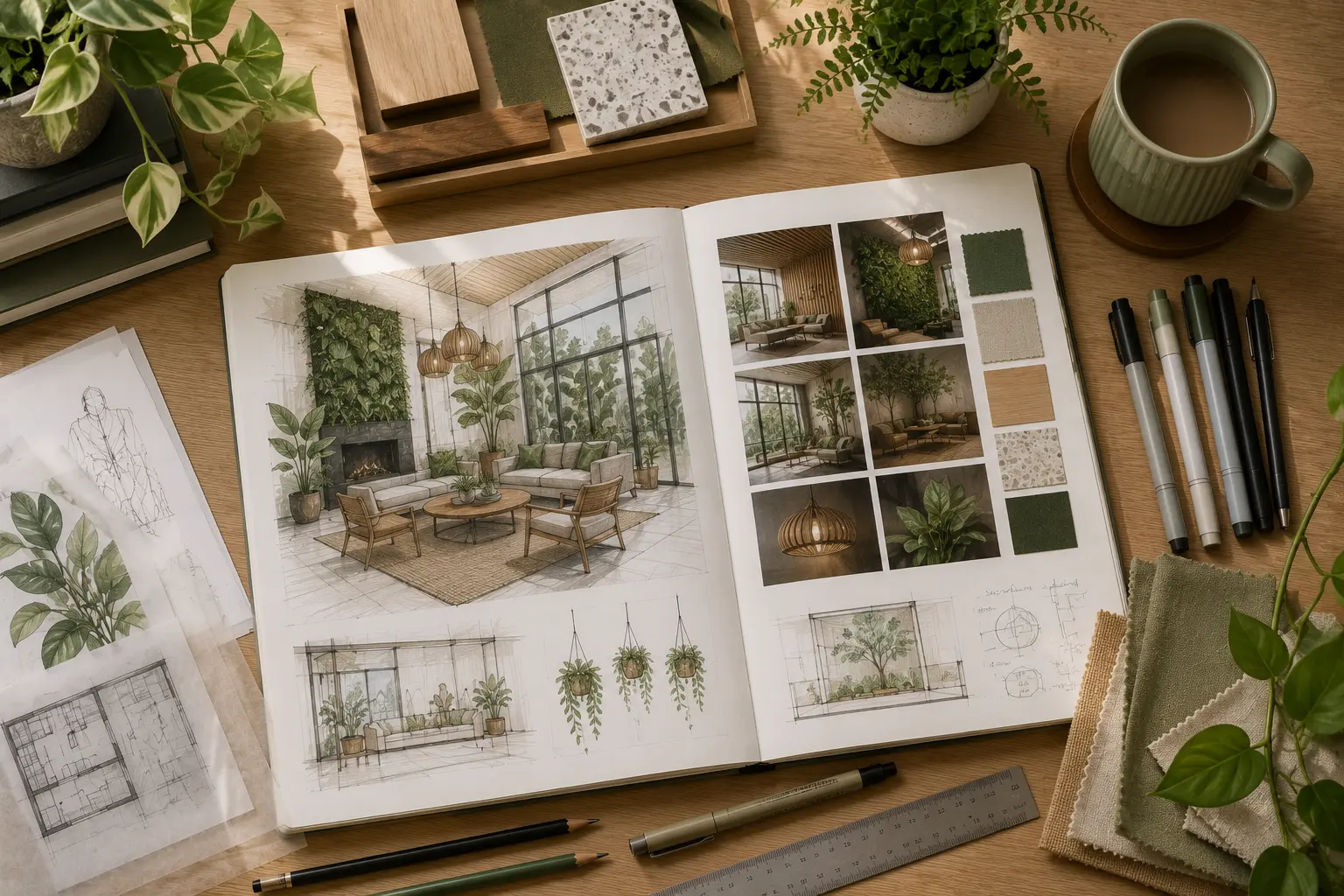
If you have been following interior design trends in the last few years, you have probably come across the term biophilic design. It shows up in architecture magazines, workplace design case studies, luxury residential projects, and increasingly in the briefs that clients bring to designers. By 2026 it has moved well past being a trend. It is now a core design philosophy that shapes how leading architects, interior designers, and urban planners approach every new project.
For interior design students, understanding biophilic design is no longer optional. It is part of becoming a competent, contemporary designer. This blog explains what biophilic design actually means, where it came from, how it works across different spaces, what real-world case studies show, and why you need to build this knowledge into your design practice now rather than later.
What is Biophilic Design: The Actual Definition
Biophilic design is an approach to architecture and interior design that deliberately integrates nature into the built environment to improve human health and wellbeing. The word biophilic comes from biophilia, a term popularized by the American biologist E.O. Wilson in 1984. Biophilia means love of life or love of living systems, and it refers to the innate human tendency to seek connection with nature and other living things.
Wilson's central argument was that humans evolved in natural environments over hundreds of thousands of years. Our biology, psychology, and nervous system developed in close relationship with nature including natural light, plants, water, animals, natural materials, and the rhythms of weather and seasons. The built environments we now live and work in, steel, glass, concrete, artificial lighting, climate-controlled air, represent a radical departure from that evolutionary context. Biophilic design is the response to that departure. It is the intentional effort to bring nature back into the spaces where we spend most of our time.
This is important to understand because biophilic design is not the same as putting plants in a corner or choosing a wood-look floor. It is a whole design philosophy grounded in human biology and supported by a substantial body of research on how natural environments affect our stress levels, cognitive function, creativity, mood, and physical health.
The Three Core Frameworks of Biophilic Design
Researchers and designers have organized biophilic design into frameworks that help practitioners apply the concept systematically. The most widely used framework identifies three categories of biophilic experience.
The first is nature in space. This refers to direct contact with nature within the interior environment. Living plants, water features, natural light, natural air movement, animals and animal elements, and natural materials like wood, stone, bamboo, and clay all fall into this category. It is the most immediately visible form of biophilic design and the one most people think of first.
The second is natural analogues. This refers to indirect evocations of nature through design elements that represent or mimic natural forms without being nature itself. Organic shapes in furniture, botanical patterns in textiles, fractal-inspired architectural details, the use of natural colors like earth tones and greens, and materials that reference nature even when processed, like leather or linen, all fall here. Natural analogues work because our brains recognize and respond positively to nature's patterns even in abstracted form.
The third is the nature of space. This is the most conceptual category and covers spatial configurations that evoke natural environments. It includes prospect and refuge, which is the human preference for spaces that offer both an open view and a sense of shelter. It includes mystery, the sense that there is more to discover around a corner or beyond a threshold. It includes awe, the experience of being in a space so large or dramatic that it produces a sense of wonder. These spatial qualities are drawn from how humans historically navigated and found safety in natural landscapes, and they influence how people feel in a space in ways that are often subconscious but powerful.
Interior design students who understand all three frameworks can apply biophilic thinking at every level of a project, from materials selection to spatial planning to atmospheric design.
| Framework | Description & Interior Design Examples |
|---|---|
| Nature in Space | Direct presence of natural elements inside a built environment. Examples: Indoor plants, living walls, natural light, water features, wood, stone, bamboo, and clay finishes. |
| Natural Analogues | Design elements that indirectly mimic or reference nature. Examples: Organic furniture shapes, botanical patterns, earthy colours, linen, leather, and nature-inspired textures. |
| Nature of Space | Spatial planning that recreates how people experience natural environments. Examples: Open views, cosy refuge corners, curved pathways, layered spaces, mystery, depth, and dramatic scale. |
Biophilic Interior Design: How It Works in Residential Spaces
Biophilic home design is one of the fastest-growing areas of residential interior practice. As remote work has become a permanent part of many people's lives, the home has had to function as a workplace, a sanctuary, and a social space simultaneously. Biophilic design addresses this by making the home a restorative environment rather than simply a functional one.
In residential interiors, biophilic design works across several dimensions. Natural light is the most fundamental. Maximizing daylight through large windows, skylights, and carefully placed reflective surfaces not only connects occupants to the rhythm of the day but has direct measurable effects on mood, sleep quality, and productivity. Biophilic home design prioritizes daylight planning from the earliest stage of a project rather than treating it as an afterthought addressed by lighting fixtures.
Living walls and indoor planting have moved from being decorative accents to structural design elements in biophilic residential projects. A living wall is not simply a collection of plants mounted on a vertical surface. Designed properly, it acts as an air purifier, a humidity regulator, an acoustic buffer, and a powerful visual anchor that changes with the seasons and the light. Advances in integrated irrigation systems have made living walls significantly more practical in 2026 than they were even five years ago.
Material choices in biophilic home design favor natural, tactile surfaces over synthetic ones. Reclaimed wood, natural stone, terracotta, linen, wool, and raw plaster all have surface qualities that engage multiple senses, including touch, smell, and the subtle visual complexity that natural materials carry. This multisensory engagement is part of what makes biophilic interiors feel different from standard interiors, even when the difference is difficult to articulate.
Water features, even small ones like tabletop fountains or wall-mounted water panels, introduce sound and movement that shift the atmosphere of a space in ways that are disproportionate to their physical scale. The sound of moving water is deeply calming for most people at a neurological level, and its presence in a home changes the quality of the environment noticeably.
Biophilic Design Office: Why Workplaces Are Leading the Application
Some of the most documented and research-driven applications of biophilic design are in office and workplace environments. This is partly because workplaces are easier to study than homes. Researchers can measure productivity, absenteeism, stress levels, and cognitive performance in controlled workplace environments in ways that are harder to do in residential settings.
The research outcomes have been consistent enough that biophilic office design has moved from a forward-thinking experiment to an expectation among employers who are competing for talent and concerned about employee wellbeing. Studies across multiple workplace settings have found that access to natural light and outdoor views is the most valued feature employees want from their work environment, ranking above cafeterias, fitness facilities, and private offices. Research has also found that employees in offices with natural elements report significantly lower stress levels, fewer sick days, and higher reported levels of concentration and creativity.
Biophilic design office applications typically include maximizing access to natural light and outdoor views for all workstations rather than reserving them for senior offices. They include introducing living plants and planting throughout the workspace at a meaningful scale rather than as token gestures. They involve material choices that introduce natural textures and reduce the dominance of synthetic surfaces. They incorporate acoustic design using natural materials and spatial planning to manage noise without creating the oppressive silence of over-soundproofed environments. They use varied spatial typologies within the office including open collaborative areas, quiet refuge spaces, and informal meeting areas to replicate the variety of environments found in natural landscapes.
Some of the most celebrated recent office designs globally have used biophilic principles as their organizing concept rather than as a layer added afterward. Amazon's Spheres in Seattle, which are enclosed glass structures filled with over 40,000 plants from around the world, are among the most dramatic examples. The outcome has been well documented in terms of employee engagement and the building's role in Amazon's employer brand.
Biophilic Design Architecture: From Buildings to Urban Scale
Biophilic design architecture operates at a scale that goes beyond individual interiors. At the building level, biophilic architecture considers how the building's form, facade, and relationship to its site connect occupants and passersby to natural systems.
Green facades and rooftop gardens are among the most visible architectural expressions of biophilic thinking. But biophilic architecture also works through the building's orientation for natural light and ventilation, through the use of courtyards that bring the outside into the heart of a building, through the selection of local and natural materials that connect the building to its geographic and cultural landscape, and through the integration of water into the landscape design surrounding the building.
At the urban scale, biophilic design architecture contributes to what planners call biophilic cities, urban environments where nature is not confined to parks but is woven through streets, buildings, transport infrastructure, and public spaces. Singapore is the most often cited example of a biophilic city approach at scale, with its Gardens by the Bay, the green facades of buildings throughout the city, and urban planning policies that require green coverage as a standard.
For interior design students, understanding biophilic architecture matters because interior design decisions do not exist in isolation from the building and the urban environment in which they sit. A biophilic interior that ignores the building's relationship to daylight and outdoor views is working against itself. The most successful biophilic interiors work with the building, not around it.
Biophilic Design Case Study: Real Projects and What They Demonstrate
Looking at real biophilic design case studies is one of the most useful ways to understand how the principles translate into practice.
The Bullitt Center in Seattle is often cited in biophilic design architecture discussions. Designed to be the world's greenest commercial building, it integrates biophilic principles at every level including maximum daylight penetration through every floor, a rooftop solar array, composting toilets, and a design that encourages occupants to use stairs over elevators by making the staircase the most beautiful and prominent feature of the building. The result is a building where occupants report high levels of satisfaction and wellbeing.
The Google offices in various global locations have been documented as biophilic design case studies repeatedly. The London, Dublin, and Zurich offices in particular integrate living walls, natural materials, abundant planting, natural light optimization, and varied spatial typologies in ways that go well beyond surface decoration. The reported outcomes include higher employee satisfaction scores and the offices functioning as recruitment tools because of the quality of the work environment.
In the residential sphere, the work of designer Patrick Blanc, who pioneered the modern vertical garden or living wall, has generated extensive biophilic design case study documentation. His vertical gardens on buildings in Paris, Madrid, and Kuala Lumpur demonstrate how large-scale living installations can transform both the aesthetic and the environmental performance of a building.
In India, biophilic design is increasingly appearing in premium residential and hospitality projects. Resorts in Kerala and Goa have long used natural materials and indoor-outdoor spatial flow as core design principles, though often without framing it explicitly as biophilic design. Contemporary design studios working on luxury residential projects in Mumbai, Pune, Bengaluru, and Delhi are now actively referencing biophilic principles in their briefs and presentations.
Why Interior Design Students Need to Learn Biophilic Design Now
There are several very practical reasons why biophilic design belongs in the working knowledge of every interior design student graduating in the next few years.
Client demand is real and growing. Clients in 2026 are not just asking for beautiful spaces. They are asking for spaces that support their health, reduce their stress, improve their focus, and align with their values around sustainability and wellbeing. A designer who can articulate and deliver biophilic design is answering a question that clients are actively asking.
It is not a passing trend. The principles of biophilic design are rooted in evolutionary biology and supported by decades of research across psychology, neuroscience, and environmental studies. It is not a style that will be replaced by the next aesthetic wave. It is a framework that will continue to shape how the best design work is done regardless of which visual trends come and go.
It intersects with sustainability. Biophilic design and sustainable design are not the same thing but they overlap significantly. Natural materials, passive heating and cooling through design, green roofs and walls that reduce urban heat island effects, and buildings that maximize natural light and reduce energy consumption are all biophilic strategies that also produce environmental benefits. Understanding biophilic design deepens your understanding of sustainable practice.
It gives you a competitive edge in a crowded graduate market. Many interior design graduates can put together a visually strong portfolio. Fewer can demonstrate that they understand the research behind why certain design decisions produce certain human outcomes. A student who can explain why they made specific biophilic design choices in their work, referencing human biology and environmental psychology alongside aesthetic considerations, stands out in a way that purely visual portfolios do not.
It is becoming part of professional standards. Green building rating systems like LEED and WELL, which are increasingly required on commercial and institutional projects in India and globally, both include biophilic design elements as part of their certification criteria. Familiarity with how biophilic principles map onto these certification frameworks is practically useful for any designer working on projects that require formal sustainability or wellbeing credentials.
How to Start Building Biophilic Design Knowledge as a Student
You do not need to wait until you are working on professional projects to develop biophilic design knowledge. Here is how to start building it now.
Read the foundational texts. Stephen Kellert's work on biophilic design, particularly his book Biophilic Design: The Theory, Science and Practice of Bringing Buildings to Life, is the starting point for anyone who wants to understand the field properly rather than superficially. E.O. Wilson's Biophilia is worth reading for the broader biological and philosophical context.
Study published case studies. The Living Future Institute, the WELL Building Standard documentation, and architecture publications like Dezeen, Architectural Digest, and Domus regularly publish detailed biophilic design case studies with photographs and design rationale. Read them critically, not just for inspiration but for understanding what specific choices were made and why.
Apply biophilic principles to your student projects. Even when a brief does not explicitly ask for biophilic design, you can apply the frameworks. Make conscious decisions about natural light, material selection, spatial variety, and the use of natural elements. Document your reasoning. This builds both the habit of biophilic thinking and a portfolio that demonstrates it.
Visit spaces that use biophilic design. In Pune and Mumbai, several premium hotels, corporate offices, and newer residential developments incorporate biophilic elements at a meaningful scale. Visit them as a student and analyze what works, what feels performative versus genuinely integrated, and what the experience of being in the space actually feels like.
Frequently Asked Questions
What is biophilic design in simple terms?
Biophilic design is an approach to interior and architectural design that deliberately incorporates nature into built spaces, through natural light, plants, water, natural materials, and spatial configurations that evoke natural environments. The goal is to support human health, wellbeing, and connection to the natural world.
What is the difference between biophilic design and sustainable design?
Sustainable design focuses on reducing the environmental impact of buildings through energy efficiency, materials sourcing, and waste reduction. Biophilic design focuses on human wellbeing by connecting built spaces to nature. They overlap significantly and often use similar strategies but they are not the same discipline.
What are common biophilic interior design elements?
Living walls, indoor plants, natural light maximization, natural materials like wood and stone, water features, organic shapes in furniture and detailing, natural colors and textures, and spatial designs that offer variety between open and sheltered areas are all common biophilic interior design elements.
How is biophilic design applied in offices?
Biophilic design office applications include maximizing natural light and outdoor views for all workstations, introducing planting throughout the workspace, using natural materials, creating varied spatial typologies, and managing acoustics with natural materials. Research consistently shows these measures reduce stress and improve productivity.
Is biophilic design relevant in India?
Yes. Biophilic design is growing rapidly in Indian interior and architectural practice, particularly in premium residential, hospitality, and corporate sectors. Indian design traditions have long incorporated natural materials, courtyards, and indoor-outdoor spatial flow, which makes biophilic principles both culturally resonant and practically applicable.
What are some well-known biophilic design case studies?
Amazon's Spheres in Seattle, the Bullitt Center in Seattle, various Google offices globally, Patrick Blanc's vertical garden installations across Europe and Asia, and Singapore's urban biophilic planning are among the most frequently referenced biophilic design case studies in design education and practice.