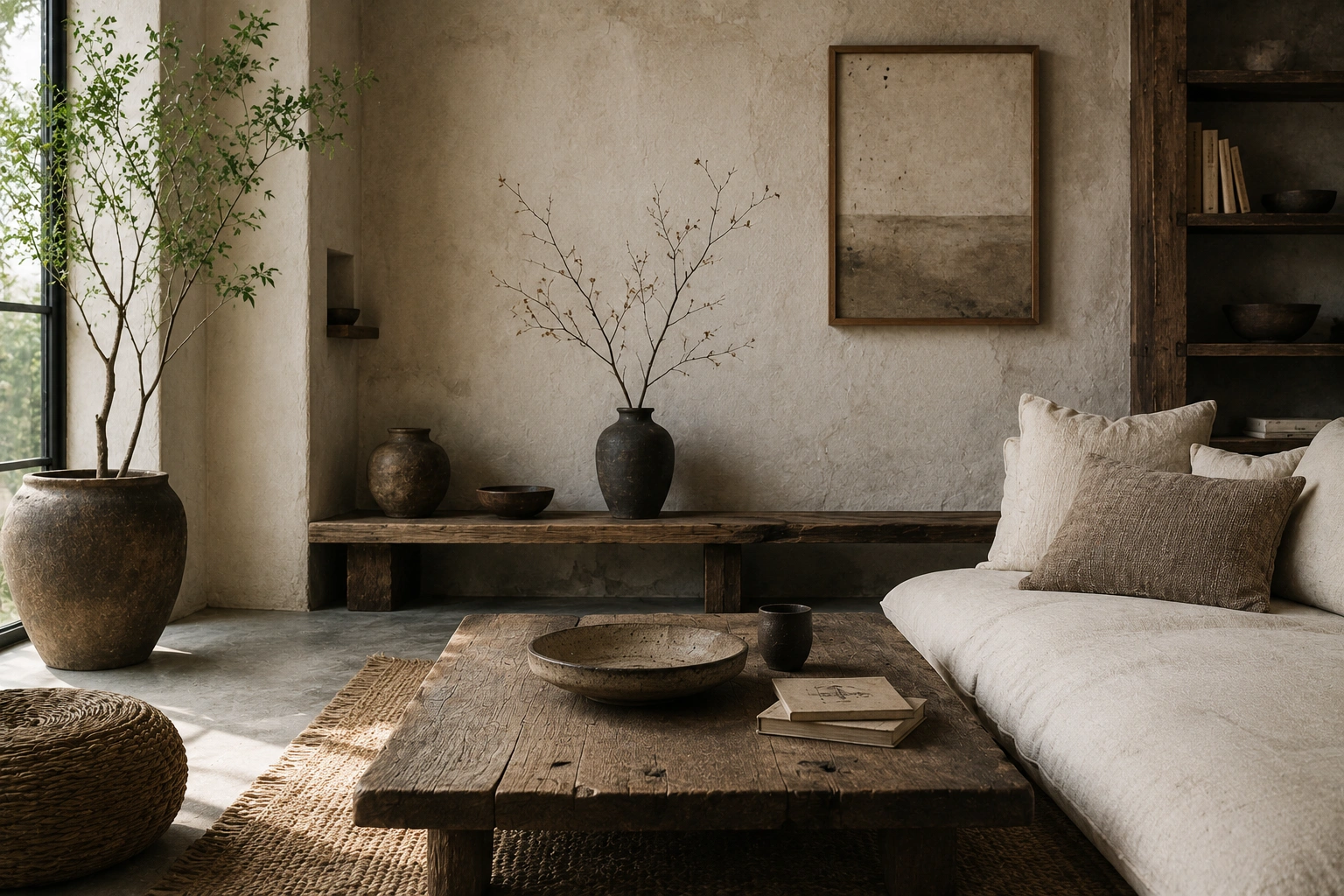
Wabi-sabi design is a Japanese aesthetic philosophy centred on finding beauty in imperfection, impermanence, and incompleteness. Rather than pursuing symmetry, polish, or newness, wabi-sabi values natural wear, irregular textures, and objects that show the passage of time. In interiors, this translates into spaces that feel lived-in, honest about their materials, and quietly imperfect rather than staged or flawless.
The Origins of Wabi-Sabi
Wabi-sabi has roots in Japanese Zen Buddhism and the tea ceremony tradition, where simplicity, humility, and acceptance of natural decay were treated as spiritual as much as aesthetic values. The term itself combines two ideas: wabi, associated with rustic simplicity and quiet, understated beauty, and sabi, associated with the beauty that comes from age and the passing of time.
While the concept is centuries old within Japanese culture, it was designer and writer Leonard Koren who introduced wabi-sabi to a wider international design audience through his 1994 book, Wabi-Sabi for Artists, Designers, Poets and Philosophers. Koren's work framed wabi-sabi not as a decorating style but as a way of seeing, one that finds meaning and beauty in things that are modest, worn, and unfinished rather than pristine. His writing remains the primary reference point for how wabi-sabi is discussed in Western art and design contexts today.
Wabi-Sabi Style: Core Principles
A few principles define wabi-sabi style across any application, from ceramics to interiors:
- Imperfection is not a flaw. Cracks, asymmetry, and irregular surfaces are treated as part of an object's character rather than something to hide or correct.
- Impermanence is accepted, not resisted. Materials are allowed to age visibly, such as unsealed wood weathering or metal developing a natural patina.
- Simplicity takes priority over ornamentation. Wabi-sabi favours restraint, with fewer objects chosen more deliberately, rather than dense decoration.
- Natural materials are preferred. Stone, clay, raw wood, and linen are common because they age visibly and honestly, unlike synthetic materials that resist change.
Wabi-Sabi Interior Design: How It Applies to Real Spaces
In interior design, wabi-sabi shows up through material choices, restrained colour palettes, and a deliberate lack of over-styling. Common elements include exposed or lightly finished wood, handmade ceramics with visible irregularities, muted earthy tones, and furniture that is functional rather than ornamental. Rooms are often kept sparse, with negative space treated as a design element rather than something to fill.
Unlike many interior styles built around a fixed colour scheme or furniture set, wabi-sabi interior design is guided more by material honesty and restraint than by a strict visual formula. A space does not need imported Japanese objects to reflect wabi-sabi; what matters is whether the materials and layout reflect simplicity, natural ageing, and quiet imperfection.
Minimalist Wabi-Sabi Interior Design vs Traditional Minimalism
Wabi-sabi and minimalism are often grouped together, but they are not the same. Traditional minimalism tends to prioritise clean lines, uniformity, and a sense of controlled precision, often using smooth, flawless surfaces. Minimalist wabi-sabi interior design borrows minimalism's restraint and simplicity but rejects its pursuit of flawlessness. Surfaces are allowed to be uneven, materials are allowed to show age, and small imperfections are left visible rather than corrected.
In practical terms, a minimalist room might use a perfectly smooth painted wall and matched furniture, while a wabi-sabi-influenced minimalist room might use a lime-washed wall with visible texture and a handmade wooden table with natural grain variation. Both are simple, but one is precise and the other is intentionally imperfect.
Japanese Wabi-Sabi Interiors: Traditional vs Modern Adaptations
Traditional Japanese wabi-sabi interiors, such as those found in older tea houses and rural homes, use natural materials like unfinished wood, paper, clay, and stone, with minimal furniture and an emphasis on empty space. Ageing and weathering were accepted as part of daily life rather than treated as damage to repair.
Modern adaptations of wabi-sabi interiors, particularly outside Japan, tend to reinterpret these ideas within contemporary layouts, using textured plaster, reclaimed wood, handmade ceramics, and neutral, earthy colour palettes. While the materials and cultural context differ from traditional Japanese interiors, the underlying principle remains the same: valuing natural imperfection over uniform polish.
Comparing Wabi-Sabi, Minimalism, and Japandi
| Style | Core Focus | Typical Materials |
|---|---|---|
| Wabi-Sabi | Finding beauty in imperfection and natural ageing. | Raw wood, clay, stone, textured finishes. |
| Minimalism | Clean lines, simplicity, and clutter-free spaces. | Smooth surfaces, uniform finishes, sleek furniture. |
| Japandi | Japanese minimalism blended with Scandinavian functionality. | Light wood, muted colours, soft-textured functional furniture. |
Frequently Asked Questions
What is wabi-sabi design in simple terms?
Wabi-sabi design is a Japanese aesthetic that finds beauty in imperfect, impermanent, and incomplete things, favouring natural ageing and simplicity over polish and symmetry.
Who introduced wabi-sabi to Western design audiences?
Designer and writer Leonard Koren introduced the term to a wider international audience through his 1994 book, Wabi-Sabi for Artists, Designers, Poets and Philosophers, which remains the primary reference point for the concept in Western design discussion.
Is wabi-sabi the same as minimalism?
No. Minimalism focuses on clean lines and uniform precision, while wabi-sabi embraces visible imperfection, irregularity, and natural ageing. Minimalist wabi-sabi interiors combine restraint with intentional imperfection rather than flawless simplicity.
What materials are used in wabi-sabi interior design?
Common materials include raw or lightly finished wood, clay, stone, linen, and other natural materials that age visibly over time, such as developing texture, patina, or wear.
Do wabi-sabi interiors need Japanese decor items?
No. Wabi-sabi is guided by principles of simplicity, natural material use, and acceptance of imperfection rather than a specific set of decorative objects. A space can reflect wabi-sabi without using traditional Japanese furnishings.
What is the difference between wabi-sabi and Japandi?
Wabi-sabi is a standalone Japanese aesthetic philosophy centred on imperfection and impermanence. Japandi is a hybrid style that blends Japanese minimalism with Scandinavian design principles, often resulting in a lighter, more uniform look than traditional wabi-sabi spaces.