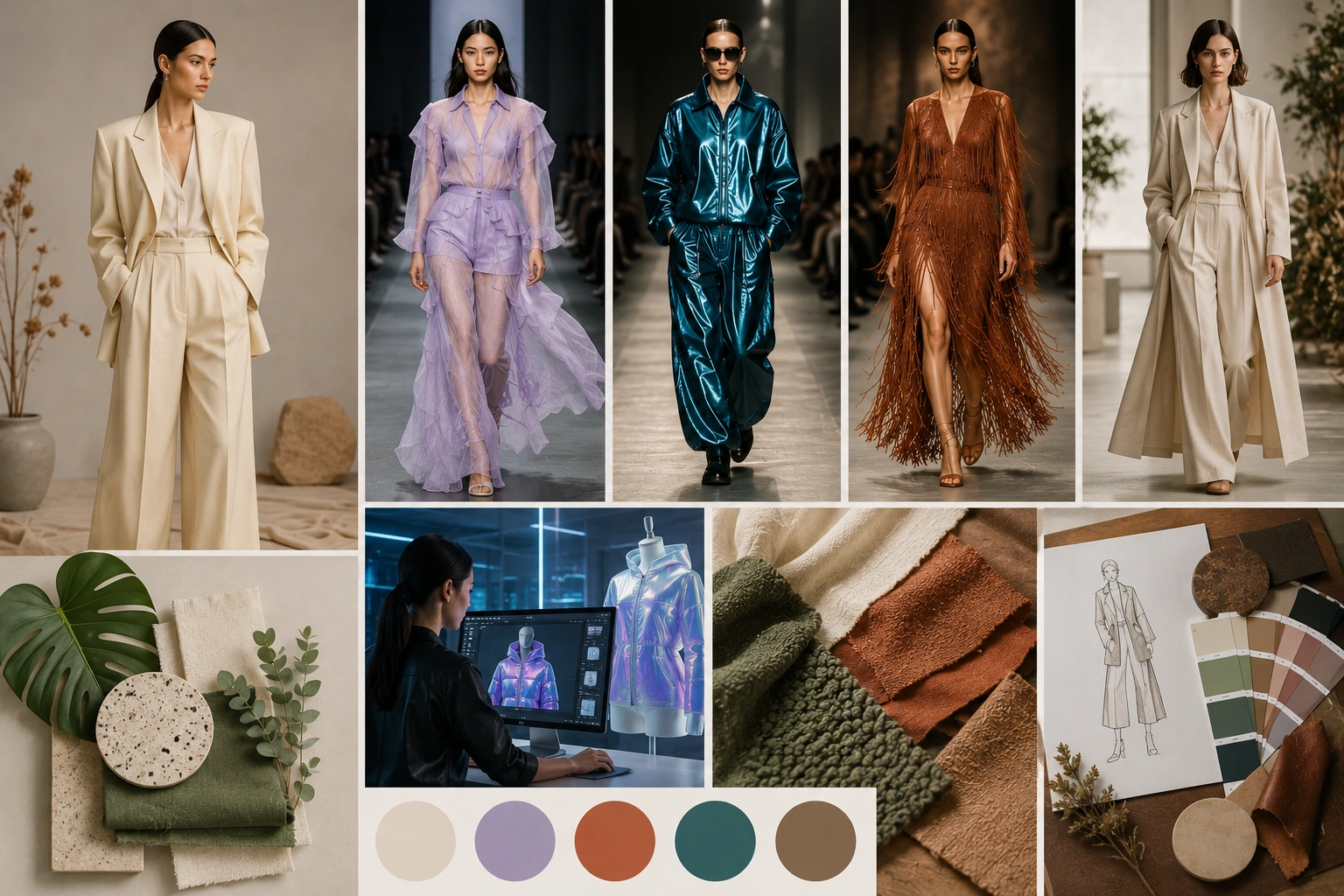
Fashion trends rarely appear out of nowhere. They emerge from a mix of runway direction, consumer mood, technology and, increasingly, regulation. The picture for 2026 is unusual because all four are moving at once: designers are producing bolder, more expressive collections while the businesses behind them navigate tariffs, tighter margins and new environmental rules. This guide looks at the trends defining the year, the forces behind them, and what they mean for anyone building a career in design.
What Is Driving Fashion Trends in 2026?
The most consistent theme across the 2026 collections has been a move away from restraint. After several seasons of quiet minimalism, designers have leaned into expressive silhouettes, saturated colour and sharper tailoring, producing collections that read as bold but remain wearable. At the same time, there is a visible pull towards what the industry has started calling wardrobe dressing: individual pieces designed to be mixed into an existing closet rather than styled head to toe.
That tension between statement and staple runs through the year. Consumers are spending more cautiously and are drifting away from microtrends towards brands with clearer values and longer product lifespans. The result is a season where drama and durability sit side by side rather than in opposition.
Fashion Trends 2026: The Looks Defining the Year
- Saturated statement colour, with chartreuse, purple and electric blue recurring across collections
- Reworked tailoring and skirt suits, softer in construction but still authoritative
- Tuxedo and evening dressing pulled into daywear, blurring formal and casual
- Sheer layering and contrast textures used for depth rather than shock value
- Heirloom detailing such as brocade, jacquard, embroidery and beadwork
- Sculptural outerwear, capes and statement shoes carrying the accessory story
Colour has done much of the heavy lifting this year. Retail buyers have reported statement shades appearing consistently through fashion month, styled through tonal clashes and bold blocking rather than as single accent pieces, alongside a strong return of full-black looks as a power statement.
Silhouette has moved in two directions at once. On one side there are exaggerated proportions, volume at the hip and dramatic outerwear shapes; on the other, a return to lean, shrunken tailoring and elongated lines. Rather than cancelling each other out, the two are being styled together, with a structured piece anchoring something fluid. Accessories have become unusually central this season, with footwear and bags carrying as much of the story as the clothes themselves.
Sustainable Fashion Trends Move From Marketing to Compliance
The most significant of the sustainable fashion trends this year is that sustainability has stopped being purely voluntary. Under the European Union's Ecodesign for Sustainable Products Regulation, large companies are prohibited from destroying unsold clothing, footwear and accessories, with the obligation taking effect for those businesses in July 2026 and extending to medium-sized companies in 2030.
Related measures are following closely. Digital Product Passports will require a verifiable record of material composition, origin, recycled content, repairability and end-of-life options, with initial textile requirements expected from 2027. Extended Producer Responsibility schemes make brands financially accountable for collecting and recycling what they sell. Together these rules push the decision point back to the design stage, since a garment's repairability and recyclability are largely determined by the fibres, blends and construction a designer specifies.
For designers this reframes sustainability as a technical constraint rather than a marketing angle. Mono-material construction, unpickable seams, durable finishes and traceable supply chains are becoming standard considerations. Resale and repair are also growing as commercial channels in their own right, driven partly by price pressure and partly by shoppers who enjoy sourcing unique pieces.
Fashion Industry Trends Behind the Runway
The commercial picture is more cautious than the collections suggest. Industry research for 2026 found that 46% of fashion executives expected conditions to worsen over the year, with tariffs identified by a large majority as the defining issue and declining consumer confidence cited as the sector's biggest challenge.
The same research points to the mid-market emerging as a strong value creator as shoppers priced out of luxury look for elevated quality at accessible prices. Executives also identified artificial intelligence as the industry's largest opportunity, ahead of product differentiation and sustainability investment. These fashion industry trends shape what actually reaches shop floors, which is often a more conservative version of what appears on the runway.
The table below summarises the main forces at work and what each one means in practice.
| Force | What Is Changing | Impact on Designers |
|---|---|---|
| Trade and Tariffs | Sourcing routes and cost structures being redrawn | Tighter cost briefs, more local sourcing |
| Regulation | EU rules on unsold stock, traceability and producer responsibility | Design for durability, repair and recycling |
| Artificial Intelligence | Adoption across design, forecasting and retail | New tools to learn, faster development cycles |
| Consumer Value-Seeking | Trading down, resale growth, mid-market strength | Emphasis on quality and longevity over novelty |
| Slower Trend Cycles | Microtrend fatigue, return to wardrobe staples | Focus on versatile, buildable pieces |
This gap between runway and retail matters for anyone trying to read the year accurately. Directional looks that dominate fashion month coverage are not always the pieces buyers commit to, and retailers tend to translate a trend into its most commercial form before it reaches shelves. Understanding both layers, the creative signal and the buying decision behind it, gives a far more realistic view of where style is actually heading.
Technology and the Future of Fashion
Much of the future of fashion is being written in tools rather than fabrics. Artificial intelligence is now used across demand forecasting, merchandising, personalisation and content creation, while 3D design software has become standard in product development. Virtual sampling allows a garment to be fitted and approved on screen before anything is cut, reducing both cost and waste. Students learning 3D design tools alongside pattern making are entering the industry with exactly the skill set brands are recruiting for.
Virtual try-on, conversational shopping assistants and digital fit technology are changing the retail side in parallel. None of this replaces design judgement, but it does change how designers work and what they are expected to deliver. The practical implication is that technical literacy is no longer optional for a creative role.
What These Trends Mean for Indian Designers
India occupies an interesting position in this shift. As a major manufacturing and sourcing base, Indian export houses and buying offices feel regulatory changes in European and American markets directly, often through compliance requirements passed down from international buyers. Traceability documentation, material disclosure and durability standards are becoming routine parts of order specifications rather than exceptional requests.
Domestically, the story is different. India's craft base, natural fibres, handloom traditions and repair culture align closely with what circular design principles are trying to rebuild elsewhere. Designers who can connect that heritage to contemporary silhouettes and modern compliance requirements are well placed, both for the domestic market and for export work.
How Design Students Should Read Trends
Trend forecasts are useful as direction, not instruction. A collection built by copying a season's runway looks tends to date quickly and says little about the designer behind it. The more valuable exercise is to understand why a trend has appeared, since the reasoning behind a shift usually outlasts the shift itself.
Practically, that means reading trends alongside the fundamentals: pattern making, fabric behaviour, construction and costing. A structured design education gives those fundamentals a place to sit, so that trend awareness becomes a design tool rather than a moodboard exercise. The designers who tend to do well are those who can hold both the seasonal picture and the technical detail at the same time.
Frequently Asked Questions
What are the biggest fashion trends in 2026?
The defining fashion trends 2026 include saturated statement colour, softer reworked tailoring and skirt suits, tuxedo dressing moved into daywear, sheer layering, heirloom detailing such as brocade and embroidery, and sculptural outerwear paired with statement footwear.
Why is sustainability such a big theme in fashion right now?
Sustainable fashion trends are being driven by regulation as much as consumer demand. EU rules now restrict the destruction of unsold stock by large companies, with product traceability and producer responsibility requirements following, which pushes sustainability decisions into the design stage.
How is technology shaping the future of fashion?
The future of fashion is being shaped by artificial intelligence in forecasting, merchandising and personalisation, and by 3D design software in product development. Virtual sampling allows garments to be fitted digitally before physical samples are made, cutting cost and waste.
What are the main fashion industry trends for 2026?
Key fashion industry trends include tariff and trade disruption, cautious consumer spending, growth in the mid-market and resale segments, and widespread AI adoption. Industry surveys found most executives expected conditions to remain difficult through the year.
Should design students follow trends closely?
Trends are best used as direction rather than instruction. Understanding why a trend has emerged is more useful than copying it, particularly when combined with strong fundamentals in pattern making, fabric knowledge and garment construction.